




Get a leg up

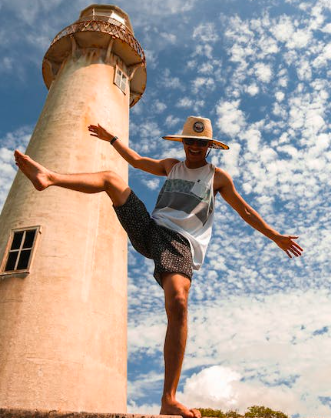
Did you play hopscotch as a kid? I remember how easy it was to repeatedly hop on one leg without falling and face-planting on concrete. Many things become more challenging with age, like confidently moving in multiple planes of motion, maintaining physical and spatial awareness, and, you guessed it—balancing on one leg. This is why physical therapists, physicians, and aging experts regard the single-leg stance as a predictor of longevity.
Maintaining balance on one leg involves our visual and vestibular (inner ear) systems and requires muscular and core strength, coordination, and efficient brain/body communication. Pretty important stuff, especially with age.
How long should you be able to hold it? Balance naturally tends to decline with age, but no single number applies to everyone. The following are general benchmarks:
Under 40: 45-60+ seconds
40-49: 30-45 seconds
50-59: 25-40 seconds
60-69: 15-30 seconds
70-79: 5-20 seconds
80-84: 3-10 seconds
85+: 2-5 seconds
The good news is that improving your single-leg stance requires no equipment and doesn’t take much time. Having a timer provides proof of progress and a healthy challenge. My mom practices while brushing her teeth, and I’ve done it while waiting for the microwave to finish. Activities like yoga, tai chi, and strength training are great for improving balance and the brain-body connection—not a bad deal.
My optometrist has observed a decline in depth and peripheral vision in his patients, both young and old, which he attributes to computer and smartphone use. Balance can worsen when the brain’s ability to process depth and periphery is compromised. To reacquaint your brain with these skills, take frequent screen breaks and gaze at distant objects each day, from several feet to dozens of yards away.
A couple of trainer tips: you’ll likely balance more easily on your dominant side, whether right or left, so spend extra time on the less stable leg. Also, it’s typically ideal to practice without shoes. This promotes proper foot function and positioning, and it heightens the brain’s sensory input.
Another longevity predictor and fun challenge is standing up from the floor without using hands. I’ve included videos of two versions: the first is the friendlier version, and the second is for challenging your friends.
If you try some or all of these balance exercises, I’d love to hear how it goes.
Interested in learning more about slowing the aging clock and ways to improve your fitness? This is what I love doing, so send me a message, and I’ll be happy to have a conversation with you.
 |
 |
|
|
|
|
Slipstream
I tried the no-hands stand-up and successfully stood up, yay... Certainly wasn't as smooth as your demo, but I'll keep practicing and get there soon. Thanks for posting the demo videos; very helpful. I'm working on extending my time standing on one leg as well.
Thanks!
Evangel
Thanks for posting these videos. Something sensible for everyone to practice no matter their age. It's nice to know there's more than one way to get back up if you get knocked down.
Sanatana
These are great! Thank you so much for posting. We need to work on being able to get up so that as we age we can do so with ease. I saw my mother decline over the years and I certainly don't want that to happen to me.
The balancing is another thing I regularly practice in my workouts. It's important to work on that daily, or at least several times a week.
Again, this was a great video that I know will help many people.
Thank you!
Youngdannville
But what about those of us who can’t kneel on our knees. Getting up off the ground isn’t pretty or easy 😂
Well Street
I suppose there's levitation. Once I learn how I'll be sure to post.
Youngdannville
😂😂😂
Slipstream
Maybe an adaptation of this technique...