




Liberators in Action: Charity Begins in Classrooms

There's a famous campaign slogan Republicans used in 1928 to usher President Herbert Hoover into the White House. It promised “a chicken for every pot,” signaling a new era of prosperity for every American. Just one year later, the stock market crashed, leading to the Great Depression of 1929.
It was a kinder time, a time when Americans of all stripes and colors came together to help each other through the hard times.
There's always something remarkable about ordinary people seeing a need and taking action. There's also something heartbreaking about the need being so great in the first place—especially today, in the wealthiest nation in the world where people can hardly afford a tank of gas or have enough to cover the grocery bill.
Across the country, schools, students, and communities are stepping in to help families put food on the table. They are building food pantries, stocking shelves, and making sure children don't have to sit in a classroom wondering where their next meal will come from.
These are the kinds of things people did during the Great Depression, when neighbors shared what they had because there wasn't enough to go around. Nearly a century later, we're doing it again.
At Skyline High School in Ann Arbor, Michigan, a storage closet a few steps from the principal's office has become a food pantry. Students can fill a bag with groceries and snacks and take it home. No questions asked.
The pantry began as a small effort in 2025, but staff saw the need grow as families faced disruptions in food assistance and rising grocery prices. By September 2026, the little pantry had become a regular part of the school community.
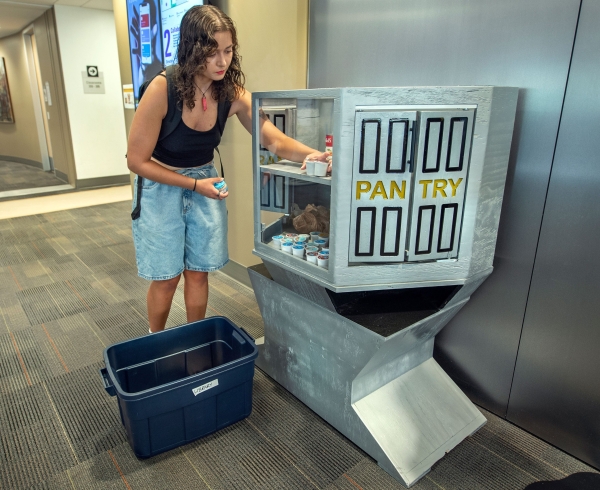
In North Carolina, students at A.C. Reynolds High School decided they could do something more than talk about hunger. Engineering students designed and built an outdoor community food pantry modeled after a Little Free Library.
The idea is simple: take what you need, leave what you can, and ask no questions. Students brought different skills to the project and created something their neighbors could actually use. The pantry was unveiled in May 2026.
And in Hillsborough County, Florida, school food pantries have grown into a massive community effort. The Feeding Minds program now provides free groceries at 30 county schools, with additional pantries throughout the Tampa Bay area.
During the 2025–26 school year, the Hillsborough program served nearly 75,000 people from more than 21,000 households and distributed more than 811,000 pounds of food. Some families walk to the school to collect groceries because they don't have transportation.
Teachers use the pantries, too.
There is glory in this.
Students are learning that helping someone can be as simple as building a pantry. School employees are making room for groceries where supplies once sat. Families are sharing what they have with families who have less.
But there is tragedy in it, too.
We live in a country with extraordinary wealth. There are people worth billions of dollars. And yet schools are putting food pantries in their hallways because children and families need food.
The people in these stories aren't waiting for someone else to fix things. They know our government has abandoned any notion of offering a chicken in every pot.
In fact, they are busy taking benefits away. But communities are not having it. Together they are figuring out a way forward. They are looking at their neighbors and saying, in their own way, we can help.
That is what liberators do.
History always repeats itself—be it a President who fails to deliver on the prosperity he promised, or a populace who steps in to fill the gaps.
History also teaches us that when we help others, we survive, and we thrive.