




Women Liberators in History: Grace Hopper

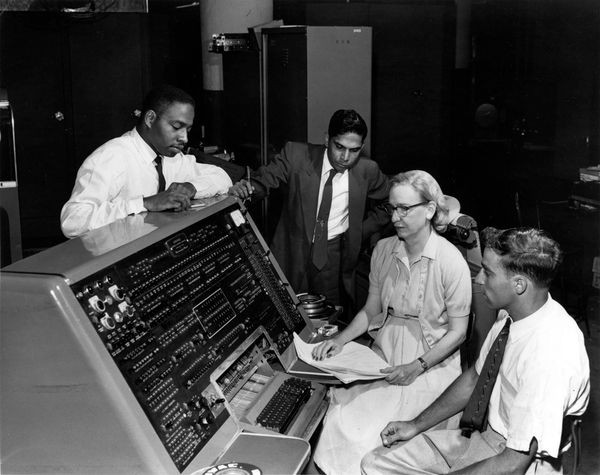
For generations, women have made contributions that shaped the world we live in; advancing medicine, building technologies we rely on every day, and pushing society to become more just. Their work has improved lives, expanded opportunities, and changed the course of history. Yet too often, their names were left out of the story or placed behind men who were given the credit.
Women’s History Month calls on us to bring to light women who made a lasting impact in their own field by seeing a need and envisioning a solution. We call them liberators for solving real-world problems that otherwise might still hold us hostage.
One such woman was Grace Hopper, a computer scientist and U.S. Navy rear admiral who created foundational concepts that would guide computing for decades. She developed the first compiler, which translated written instructions into machine code, making programming more accessible and practical. She also helped coin the term “bug” to describe a computer malfunction, a term still used today.
Hopper went on to play a central role in the development of COBOL, one of the earliest programming languages designed for business use. She believed computers should be usable by more people, not just specialists, and pushed that idea forward through her work, teaching, and leadership in the Navy. She lectured widely, often predicting that computers would one day be small enough for everyday use, something that seemed far-fetched at the time. Many of the systems used in finance and government today still reflect her influence.
Grace Hopper shaped our world with ideas that ultimately led to Steve Jobs developing Apple computers, and inspired new generations of women to enter through doors that had once been open only to men.
Women have always been liberators—often pushed out of view working alongside, and sometimes in front of men, doing the heavy lifting, shaping the world, and carrying it forward. Throughout the rest of March, we'll continue to feature women Liberators in History. We hope you enjoy learning about their stories.
Well Street
Wow, a professor at Vassar College before beginning her groundbreaking work in the Navy. There's little doubt her ascent to professorship was an uphill battle.
Computers were never a topic that got me fired up, but I bet that sitting in on one of her lectures would be most interesting. Being a visionary, she'd likely not be at all surprised that we carry computers in our pockets, each with more power than what was used to put men on the moon.
Thank you for sharing.
Slipstream
Given today's climate of stripping women's rights, it's more important than ever to push women and their accomplishments to the forefront. Thank you!