




Why Are We Still Muddling Along In War & Conquest?

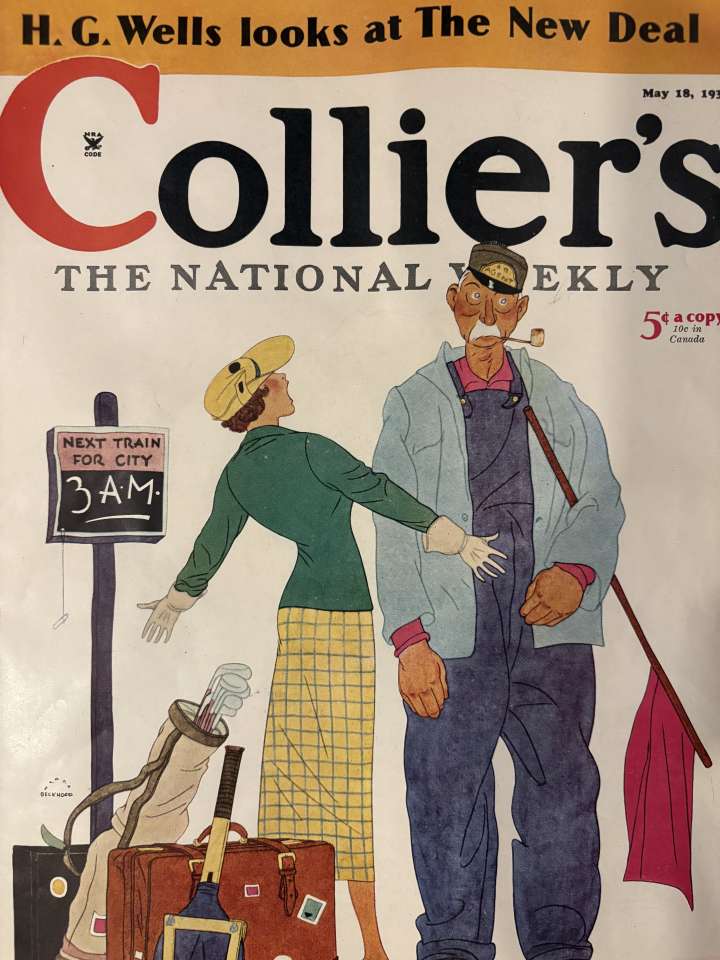
Recently, I was cleaning out my attic and found an old copy of Collier's magazine dated May 18, 1935. It's in good enough shape to read despite being 91 years old. Aside from being struck by its glamorous cigarette ads, I was drawn to an article by H.G. Wells entitled “The New America.”
H.G. Wells was a prolific 20th century English writer who wrote over 40 novels including his prophetic “The War In The Air,” published in 1909. A futurist at heart, Wells imagined the birth of new technologies yet to be invented including aircraft, space travel, nuclear weapons and biological engineering.
In his essay “The New America,” I couldn't help but notice how the challenges he addresses aptly reflect the disruptive times Americans are once again living through. In his view, the accelerated pace, scope, and precision of communications and new technologies have throughout history triggered social chaos. But he doesn't blame these advancements for the tumult that follows in their wake. That, he says, rests on humanity’s shoulders:
“For centuries mankind has, so to speak, muddled along with war and conquest. Though predominance has passed from this people to that, progress and the race have continued; but it is being realized now by great multitudes that war has changed in its nature altogether. It has changed to something monstrous and dreadful and anti-human. This realization is now quite widespread. It is not necessary to "rub it in." Humanity is, as a matter of fact, doing remarkable little to arrest this swelling and advancing menace, but that something ought to be done is no longer to be argued.”
We could imagine he’s a seer speaking about visions of AI and space weapons. But then he turns to the economy, which also sounds eerily familiar.
“Secondly, there is a world-wide economic distress, due to the fact that with increasing productive efficiency, the production of commodities by a system of unrestricted competition for profit in an open market is giving less and less satisfactory results. Man is choked with food production—and starves. Economic life is ’stalling,’ and a diversity of experimental controls and restrictions is being attempted throughout the world. Huge sections of the population are in discomfort, distressed and worried and—what is extremely dangerous—unemployed and hopelessly bored. Millions are suffering acute physical misery. And in the face of overproduction, this is felt to be needless misery.”
If you’re not feeling such pain yet, count yourself lucky. AI is replacing jobs every day, leaving people stranded, creating more needless misery. Did he foresee this, too, or are we just repeating history, doing away with last century’s safeguards that were enacted following its devastating 1929 depression?
He goes on to speak about finance, painting a clearer picture of its brain-twisting intricacies than any fund manager ever has.
“Thirdly, tangled up with and tangling up the industrial muddle is the exaggeration of finance that has gone on in the past century, so that property which was once mainly tangible, and responsibility which was once fairly traceable, are lost in an intricate network of checks, counters, stocks, shares, claims and concealing and untraceable complexities. Clever and cleverest people ’play’ the markets, gambling in this intricate confusion, snatch fortunes, spend, disorganize and tangle the natural difficulties of our situation into knots we cannot even cut.”
Finally, Wells asks the reader: “Why are all the proffered solutions so unsatisfactory? What stands in the way of assured, effective solutions and efforts to meet the world’s great problem?”
His answer is truly one for all of us to meditate on.
“Each one of us, long before we begin to take up the large questions of social and political and economic life, has gone far to develop a ‘way of living’ of his own, has built up a complexity of affections, ambitions and submissions, and accepted a thousand uncriticized assumptions. It is in our human nature, as it is in the nature of every living thing, for each individual to defend the ‘way of living’ into which he has fitted himself from the cradle onward.
“We resist changes that invade our developing personalities. We dread foreign and unfamiliar things. Our family, our schoolmates, our personal rivals loom larger than mankind; our home town hides the world from us; family pride, patriotism, race prides defend the precious self at the core of things. We insist we must work, reckon, talk as we are ‘used’ to do. We are all like that. In our hearts all of us, the whole two thousand millions of us, are instinctively on the defensive against the cold great challenge of these new conditions, against this new commandment for change.”
He gives the reader an example of the kind of change one should expect.
“We know that the New War is going to be a fundamentally different thing than the wars of the past. It is going to be a horror of mechanism, gas and pestilence that may go far to dissolve anything like a civilized order altogether; and it is moreover plain as daylight that it needs only the fiat of five or six great governments willing to fuse their foreign offices for war to cease from the world forever. But we do love our waving flags, our competitive patriotisms, the brave uniforms and the band, that we cannot nerve ourselves for that strange new calm of a boundless world at peace. Even another world war may be needed before we bow to the plain logic of the situation.”
And then the new war came. And there stood Hitler who decided to purify the race by eliminating all Jews, so help him God. And, this week, standing tall before the United Nations, our own madman, America’s president threatened to annihilate a different race of people—the Iranians—and do it quickly.
And we all watched. Quietly. Expressionless, numbed beyond caring, inured to his madness and, for some, secretly entertained by his “bombast” that dared to dangle a genocide in front of us all, as if it were the pinnacle of strength and raw patriotism. We allowed it, and slid back into our comfort zones of business as usual.
It’s maddening. It’s sad. It’s disgraceful. But it’s America.
Sanatana
Excellent piece. It really resonated with me. I love the quote ... "Man is choked with food production--and starves." How true.
I feel sick with our current situation. This piece was on point. Thank you!
Evangel
What's most disturbing is that we have become a failed nation, a once-upon-a-time great leader in the world where our democratic system was active and effective. No longer. So long as one party tries to dominate and illegally pulls out all the stops to do so, and so long as the public barks about it but does nothing to put an end to it, the end of us has come.
Thanks for commenting!
Present Valley
This article does give me hope. 91 years ago struggling with some of the same things and "we kept going." I don't like what is going on right now.
I would be the last person to guess how this is all going to work out...however because we are still here I'm hoping we've got at least another 91 years and in that time we will truly have a new more humane America. As you say, it is maddening, it is sad, it is disgraceful and it is America.
Evangel
I so appreciate your hopefulness. I think one way that could happen is for people to realize how stuck they've become politically--rooting for one party, believing it will solve their problems, though it does not, and refusing to vote for the other out of loyalty to the deceitful one they've stuck by, or out of fear that it is evil (as the GOP continues to drill into them). Thanks for commenting!
Well Street
There's so much to wrap my head around from this article. Admittedly, I'm ignorant of most of Wells' works, aside from War of the Worlds. It was as if he wrote this piece while peering through a looking glass at our present day, and he saw clearly the many parallels to his own time.
In his description of the financial system as "an intricate network of checks, counters, stocks, shares, claims and concealing and untraceable complexities," I half expected a mention of crypto.
Though 91 years isn't long in the scheme of things, Wells' account of how people think, feel, and behave reads like a blueprint for the modern human that spans centuries. Though we've had countless technological advances and, in many ways, are more sophisticated than our 1930s counterparts, we're essentially unchanged.
As a science fiction fan, I've seen shows and movies where alien races deem Earth's inhabitants too violent, fearful, greedy, and unevolved to make contact with. Wells may have thought so, too.
Thank you for this great piece.
Evangel
Right. It's like Wells entered a time warp or space travelled into the future! It also seems that some people suspect aliens are already here and are particularly focused on our nuclear launch sites, which some believe aliens have the capacity to disable.
Wilsons Grave
Business as usual comforts us, feeding our parasitic need for more novelty and profits while detaching us incrementally from our heart and soul.
Evangel
Sounds true to me. Thanks for commenting!
Slipstream
“Use us dear Lord, as never before as part of a great and mighty plan for the healing of this world.
May we no longer be at war with each other.
May we no longer be at war with ourselves.
Let us forgive this century and every other, the evils of history, the pain of our common fears.
Remove from our hearts the illusion that we are separate.
May every nation and every people and every color and every religion find at last the one heartbeat we share.”
Excerpt from “Prayer for the World” from the book Illuminata by Marianne Williamson.
Homeless Valley
I really relate to this. Nobody now feels very good about the direction we're going in, but no one seems to be able to stop it. It's pretty scary who we've become. It's not the way I'd like my country to go down in history. It's just such a dark and ugly chapter, and I agree it's disgraceful.
Thank you for posting, and thank you Slipstream for the beautiful prayer. May it be fulfilled!